
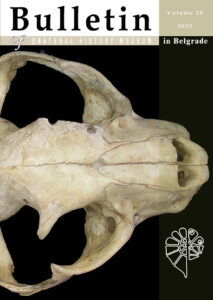
Volume 18 (2025)
Anniversaries
At the beginning of the 19th century, Serbia won its independence from the Ottoman Empire. The rapid development of science and various disciplines, including mycology, started soon thereafter. The first significant texts containing data on fungi from this area appeared as early as at the end of the 19th century. This text discusses the development of mycology on the Faculty of Biology in Belgrade from that time until the late 1980s, defining and analysing the key moments, the main drivers and the most important researchers-mycologists who laid the foundations and developed the study of mycology at the biology department. Information about some of the above does not exist in written sources or is very difficult to find.
Key words: History of mycology, fungi of Serbia, Milutin Jelić, Vojteh Lindtner
Full text (Bulletin 2025_01.pdf)
Geology
Alaburić, S., Paunović, M., Marković, Z.
Remains of the eurasian lynx (Lynx lynx, Carnivora, Mammalia) from Mandina Cave (Eastern Serbia)
This study provides a description of the ancient cranium and both branches of
the mandible of a male Eurasian lynx (Lynx lynx) from Mandina Cave (Eastern
Serbia). Cranial, mandibular, and dental measurements were obtained using
standard methodology, and their analysis allowed comparisons with other known
remains of the Eurasian lynx, as well as with the geographically closest extinct and
recent subspecies.
Key words: Lynx lynx, Mandina Cave, cranium, mandible
Full text (Bulletin 2025_02.pdf)
Biology
Niketić, M., Anačkov, G., Zlatković, B., Perić, R., Aćić, S., Janišová, M., Lazarević, P., Kuzmanović, N., Peškanov, J., Obradov, D., Radak, B., Bokić, B., Lakušić, D., Vukojičić, S., Buzurović, U., Tomović, G.
Material on the Annotated Checklist of Vascular Flora of Serbia. Nomenclatural, taxonomic and floristic notes VII
This paper proposes a novel nomenclatural combination and establishes two
previously unrecognized synonyms of the plant taxa. In addition, one new genus and two species of vascular flora for Serbia (one autochthonous and one allochthonous plant) are presented. A confirmation of old or unreliable literature records for
eight autochthonous species and subspecies and one spontaneous hybrid plant in
the flora of Serbia has been done. For the territory of Vojvodina province we
confirmed the presence of one native and one alien species, as well as two new
plants for Kosovo and Metohija province. In the last part of the paper, there is a
review of six disputed taxa for our country as well as one for Serbia proper.
Key words: vascular flora, checklist, nomenclature, taxonomy, Serbia
Full text (Bulletin 2025_03.pdf)
Tomović, G., Niketić, M., Lakušić, D., Zlatković, B., Vukojičić, S., Anačkov, G., Bogosavljević, S., Buzurović, U., Duraki, Š., Djordjević, V., Đurović,S., Kabaš, E., Kuzmanović, N., Lazarević, M., Lazarević, P., Mladenović, Ž., Obradović Novaković, J., Perić, R., Stevanoski, I.
Material on the Red Book of Flora of Serbia III – Vascular plants I (Regionally extinct and critically endangered taxa). Chorological notes
The paper presents new and unpublished distribution data of 45 species and
subspecies that will be included in the publication “The Red Book of Flora of
Serbia III – Vascular plants I (Regionally Extinct and Critically Endangered
taxa)”. Of this number, 25 taxa have been previously processed in the “The Red
Data Book of Flora of Serbia 1 – Extinct and Critically Endangered taxa”
(Stevanović ed. 1999) and new chorological records not previously published in
this publication are presented here. These data include either old herbarium
specimens that were not available at the time of the publication of the Red Book, or
newly discovered localities in the last 27 years. In some cases, already known
localities are presented, but with new data on the status of populations. In addition,
for 20 species and subspecies which will be included for the first time in a
publication “The Red Book of Flora of Serbia III – Vascular plants I (Regionally
Extinct and Critically Endangered taxa)” new distribution records are also
presented.
Key words: vascular flora, Serbia, extinct taxa, critically endangered taxa,
distribution
Full text (Bulletin 2025_04.pdf)
Kuzmanović, N., Varelova, A., Vukojičić, S.
New data on the distribution of Dryopteris dilatata (Hoffm.) A. Gray (Dryopteridaceae) in Serbia
During field research conducted in central and western Serbia, new populati
ons of Dryopteris dilatata were discovered on the mountains Kopaonik, Golija,
Tara and Jelova gora. In view of the existing taxonomic challenges within the
complex to which D. dilatata belongs to (D. carthusiana agg.), flow cytometry was
employed to validate the identifications made during the fieldwork. On Mts. Golija
and Kopaonik, the species has been documented in forests of the Piceetum abietis
type, while on Mts. Tara and Jelova gora it occurs in mixed deciduous–coniferous
forests of the Abieto-Piceeto-Fagetum type. On Mt. Jastrebac, the species was
recorded in deciduous forests of the Aceri heldreichii-Fagetum type. The presence
of D. dilatata has been observed on both silicate and limestone substrates,
suggesting that its distribution is not limited to any particular geological substrate.
However, to date, it has not been observed on serpentine substrates.
Key words: Dryopteris dilatata, Serbia, strictly protected species, new records
Full text (Bulletin 2025_05.pdf)
Ajduković, M., Vučić, T., Vukov, T., Urošević, A., Cvijanović, M., Tomović, Lj., Ivanović, A.
Research on crested newts in Serbia: insights from a hybrid population (Triturus ivanbureschi × T. macedonicus) as a baseline for breeding and hybridization studies
The large-bodied newts (Triturus sp.) of the Balkan Peninsula have long posed a challenge for taxonomists due to their complex hybridization patterns and morphological variability. These newts, belonging to the Salamandridae family, are comprised of ten species divided into two main clades: the crested newts and the marbled newts. Over the years, advances in molecular research have significantly refined the taxonomy of Triturus, revealing cryptic species, clarifying species relationships, and resolving hybridization issues. The complex hybridization zones among the crested newts, particularly in the Balkan Peninsula, have led to significant phenotypic variation, complicating species delimitation. In Serbia, the presence of multiple subspecies and hybrid populations has been extensively studied, particularly in regions where high variability among individuals and sexes is observed. This study focuses on the Vlasi population, situated at the contact zone between two species, T. macedonicus and T. ivanbureschi. Our findings suggest that this hybrid population exhibits intermediate phenotypic traits and maintains a uniform sex ratio. Interestingly, significant differences in body size were observed between phenotypes. Additionally, significant body size differences were observed between males and females, and the seasonal phenology indicated a marked decrease in activity as the year progressed. These results contribute to our understanding of hybridization dynamics and the intricate taxonomic relationships within the Triturus species in the Balkan Peninsula. In conclusion, the Vlasi hybrid population of T. macedonicus and T. ivanbureschi exhibits a diverse range of phenotypic variations, providing a valuable model for studying hybridization, life-history traits, and evolutionary processes in newts. We dedicate this paper to Prof. Dr. Miloš Kalezić, whose pioneering work on newts in the territory of the former Yugoslavia laid the foundation for future research on amphibians, including the present study. His commitment as a professor and mentor has inspired many generations to continue work in this field.
Key words: Amphibians, Caudata, conservation, hybrids, phenology, Vlasi village
Full text (Bulletin 2025_06.pdf)
This paper presents the diversity of the herpetofauna of Mala Vrbica and Vajuga in the municipality of Kladovo, as well as potential factors threatening amphibian and reptile species in this area. Field research was conducted during the year 2024. Based on field research and literature data, the research area is inhabited by 23 species (of which 13 species are amphibians and 10 species are reptiles), which makes up 50% of the autochthonous herpetofauna of Serbia. Potential factors threatening the herpetofauna of this area are: expansion of agricultural land, fires, illegal landfills, and potentially the use of pesticides in agricultural production.
Key words: diversity, amphibians, reptiles, Mala Vrbica, Vajuga, threat factors
Full text (Bulletin 2025_07.pdf)
In memoriam
Maran Stevanović, A.
Dr Rajka (1925–2023–2025)
Full text (Bulletin 2025_08.pdf)
